I Am Eliorah
Eliorah was not born into prominence, nor did he seek it. His life has unfolded quietly, shaped less by ambition than by attentiveness—to people, to places, and to the unseen currents that move through both.
Silence, he learned early, was not empty. It was instructive.
He was born in the late 1980s, during a season when desert winds carried more than dust across the border into Southern California. Those who knew him as a child would later say there was always something slightly elsewhere about him—not distant, but listening.
Even as an infant, he was said to fall silent when rooms grew tense, his attention drawn not to voices, but to what lingered between them.

When people spoke to him honestly, they felt better afterward — not because he offered answers, but because he listened.
His earliest memories were not of events, but of presences. Long afternoons on cool tile floors. The hum of refrigerators. Traffic moving like breath beyond thin walls. He remembers the way rooms felt when nothing urgent was happening, when no one was asking him to explain himself or hurry along.
Even then, silence did not feel empty to him. It felt inhabited. Like something patient was already there, waiting without expectation. He learned early that stillness could hold more than noise ever did.
As a child, Eliorah gravitated toward older relatives—grandparents, great-aunts, neighbors who spoke slowly and expected little. They did not quiz him about his future or correct his posture. They let conversations wander and allowed pauses to remain unfinished. It was among them that he first noticed his peculiar effect on others.
People lingered when he was near. They spoke longer than they meant to. They repeated stories they had already told. He did not interrupt or redirect them. He simply stayed, as if time had loosened its grip slightly in his presence.
By the age of eight, he had developed a quiet ritual with his cousins. When they were upset, they would sit with him on the back steps. He listened. He nodded. He sometimes offered a piece of candy.
The candy mattered less than the listening. What mattered was that nothing was being fixed. No one was being rushed toward feeling better. The sadness was allowed to finish its sentence.
Only later did he understand what was happening. Even then, he knew instinctively that attention—unforced, unhurried—was a form of care. And that staying, without trying to improve the moment, was often enough.
The spirits, he believed, gathered when someone felt truly heard.
His adolescence was marked by solitude. While others searched outward for belonging, Eliorah turned inward, walking long distances through neighborhoods changing faster than people could name.
Strip malls replaced orange groves. Freeways cut through old communities. He learned to notice grief beneath vacant lots and hope clinging to bus stop benches.
These walks became a way of listening without asking questions. He paid attention to what lingered — hand-painted signs fading in the sun, a single chair left outside a closed storefront, the way certain corners still felt held despite everything that had moved on.
Over time, he understood that places carried memory the way people do. They absorbed loss quietly and continued anyway. This taught him that change did not erase meaning; it simply rearranged where meaning learned to wait.
After high school, Eliorah lived modestly, taking work where it was offered. He never sought formal spiritual training, finding institutions loud and impatient.
He trusted experience more than instruction. What mattered to him was not how belief was explained, but how it behaved when nothing was happening — whether it could sit, remain, and listen without needing to be affirmed.

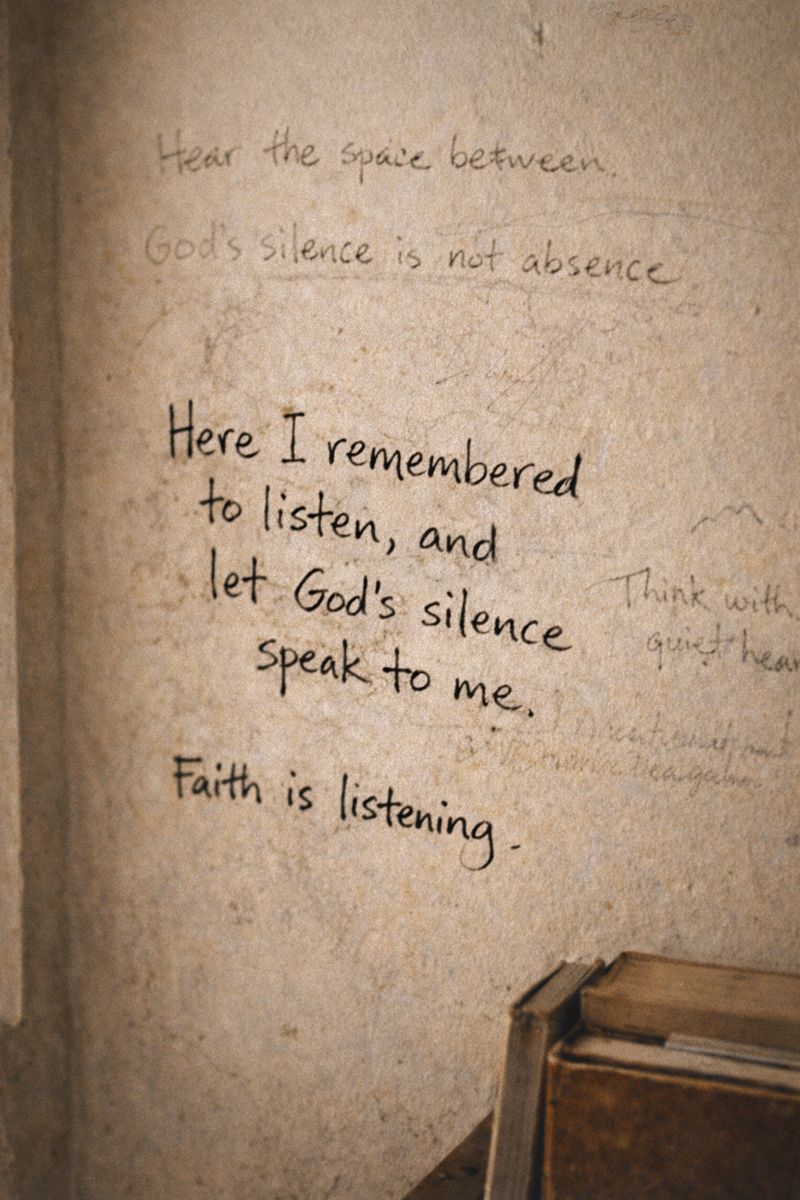
Faith, for him, was not certainty — it was loyalty to listening, even when no answer arrived.

Instead, he learned by proximity—to the elderly, the overworked, the overlooked. For years, he volunteered to help seniors travel to and from day care facilities, turning traffic-heavy rides into extended conversations.
For more than thirty years, Eliorah has guided individuals through moments of uncertainty, grief, and quiet desperation. His clients have included the neighborhood Amazon delivery team, Mark the mailman, the Subway sandwich artist on Lincoln, Hollywood craft services professionals (he was an extra once), various OnlyFans women, and some randos in line at his local coffee shop (where he works).
What people often noticed was not advice, but relief. He did not rush them toward insight or resolution. He let stories unfold at their own pace, trusting that being heard without interruption was often the first moment of rest they had experienced in years.
Understanding God’s Silence is his first digitally published work. For decades, his thoughts lived on the walls of his home, slowly fading and evolving into a website!
This book captures only a portion of his perspective—an offering for those who find themselves praying into quiet and wondering whether silence means absence.
Be sure to check out his current book: Understanding God's Silence
Check it out here
